
Mava Games presents
22 thinking games. One app.
Deduce, plan, fit shapes and crack numbers. Twenty-two different puzzles, each with its own rules and 120 levels, and not one timer rushing you.
- Works offline
- No account
- 30 languages


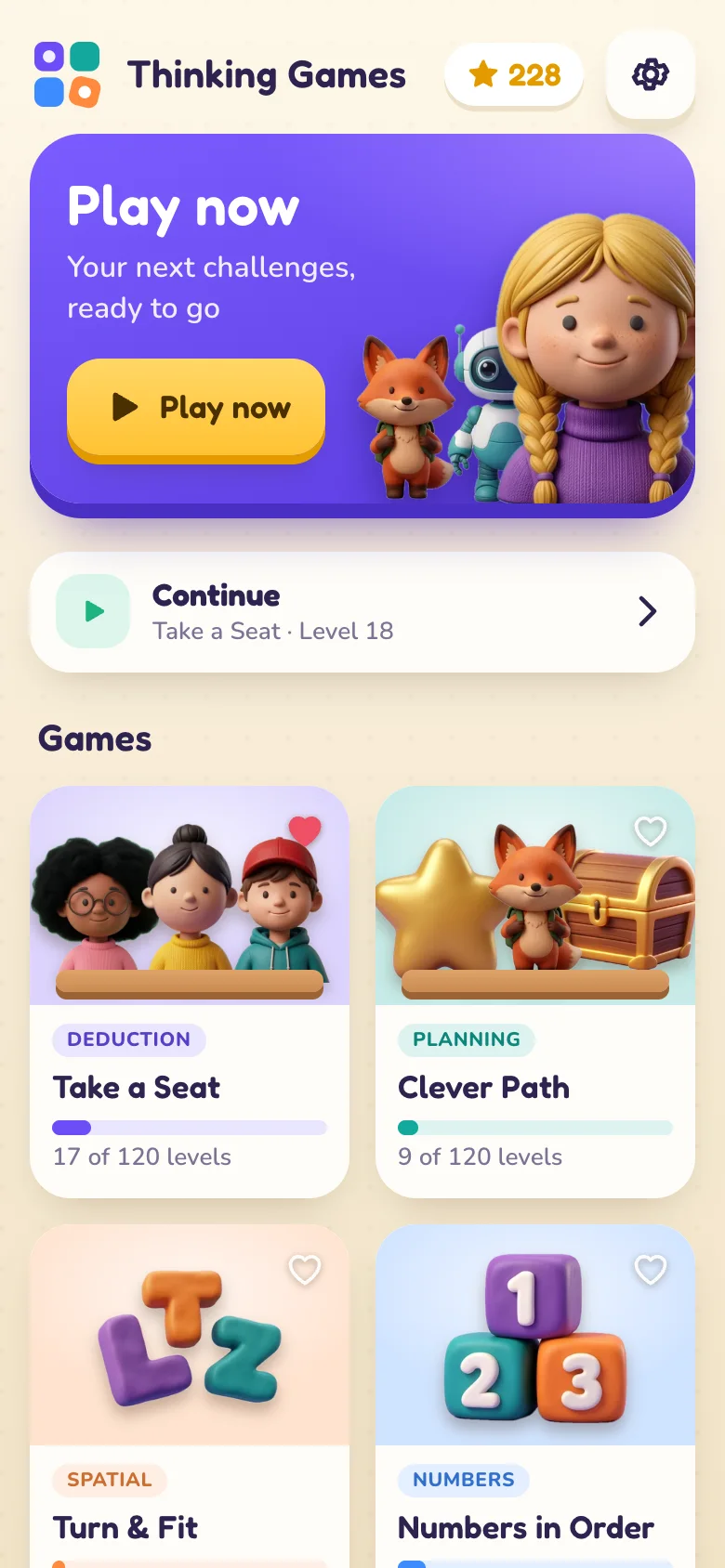




Trailer
Thirty-six seconds of it
Everything you see is the game itself, recorded as it plays.
Try one right here
This is “Light Them All”
One rule: tapping a bulb flips it and the bulbs right next to it. Turn all nine on. It is the same game as in the app, on a small board.
The app has 120 boards of this game, and 21 other games.
Solved!
The collection
Twenty-two games, not twenty-two skins
Every game has its own rule and its own board. Changing colours does not make a new game, so we did not count those. Tap any of them to see the real screen and its rules.
Read the clues, rule things out, be sure.Think several moves ahead before you touch anything.Turn it, fit it, picture it in your head.Small sums, big consequences.
-
 Deduction · 120 levels
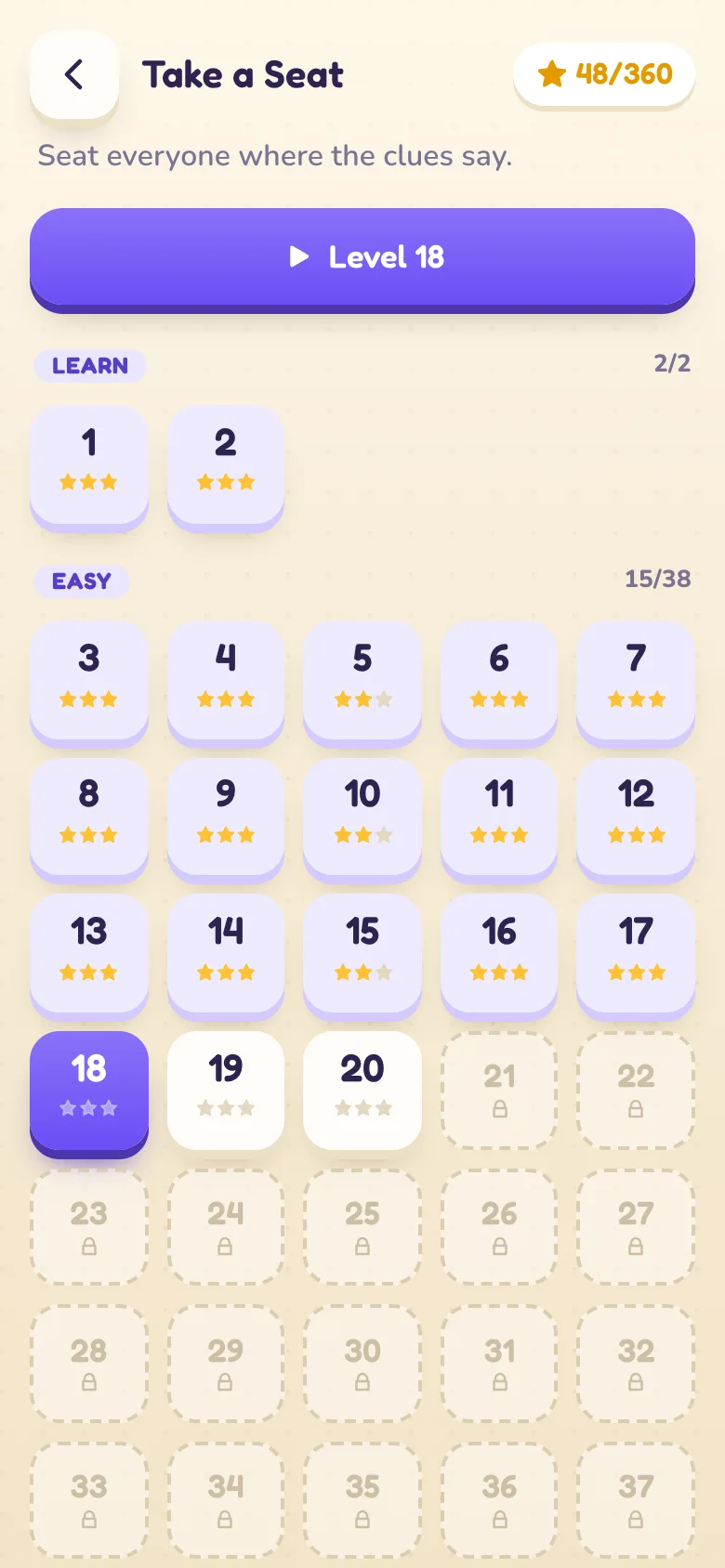
Take a Seat
Seat everyone where the clues say.
How it is played
- Tap a character, then tap a seat. You can also drag.
- Left and right are as you see them on the screen. Seat 1 is the leftmost.
- Every clue must be true at the end. There is exactly one way to do it.
-
Deduction · 120 levels
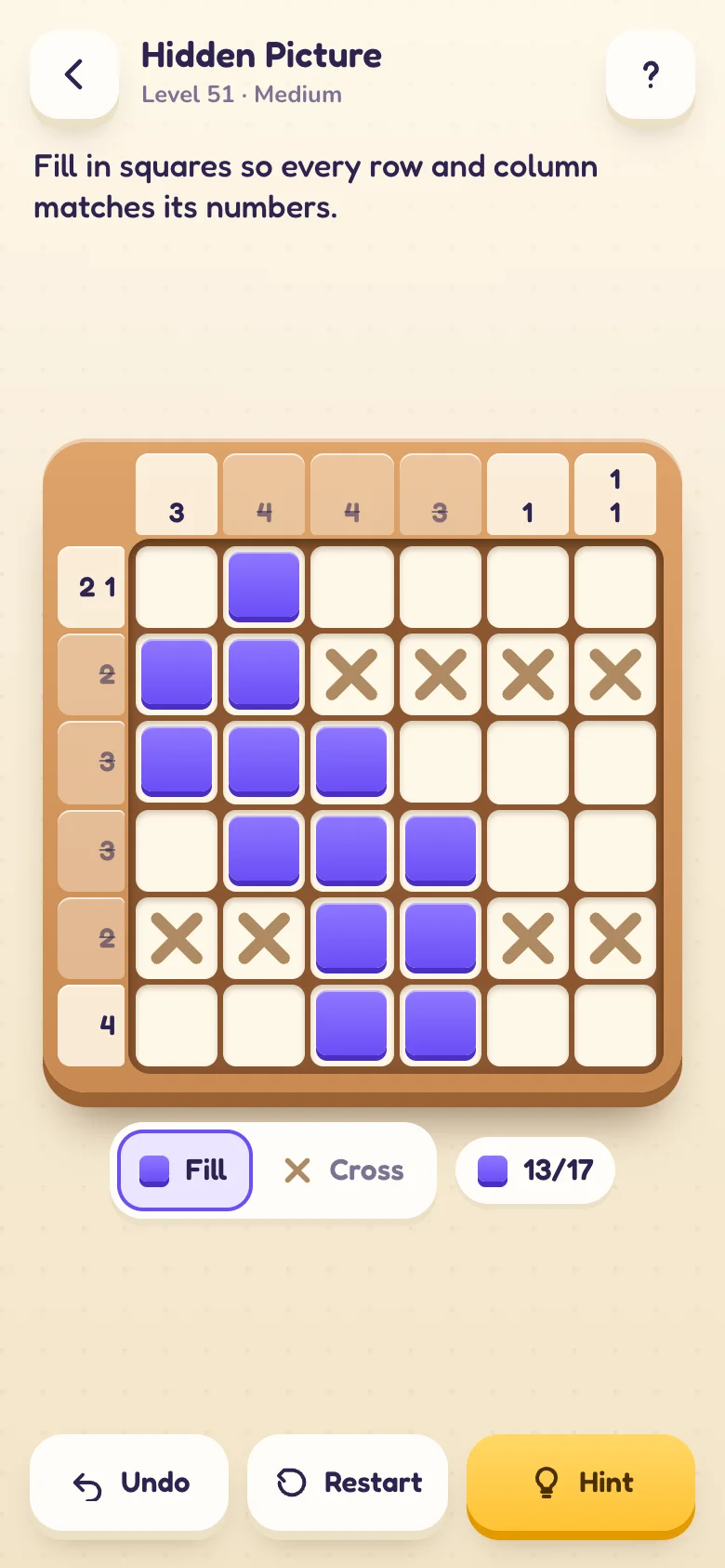
Hidden Picture
Use the number clues to fill in the picture.
How it is played
- The numbers beside a row and above a column give the lengths of its groups of filled squares, in order.
- Groups in the same row or column have at least one empty square between them.
- Tap a square to fill it; tap again for an ✕, your own note that it stays empty. Drag to paint several squares. Only filled squares count.
-
 Deduction · 120 levels
Lonely Stars
One star per row, column, and region. None may touch.
How it is played
- Every row, every column, and every region needs exactly one star. Regions are the colored areas outlined by a thick border.
- Two stars can never touch, not even at a corner. Stars that break a rule turn red.
- Tap a square to mark it with an X for “no star here,” tap again for a star, and once more to clear it. X marks are your own notes and never count.
-
 Deduction · 120 levels
Crack the Lock
Work out the code from the attempts already made.
How it is played
- No digit repeats in the code. Each attempt shows how many of its digits are in place, and how many are in the code but misplaced.
- Tap a position on the lock, then a digit. Position 1 is the one on the left of the screen.
- Under “Possible digits”, tap a digit to cross it out or mark it as sure. Those are only notes. The lock opens when your code fits every attempt.
-
Planning · 120 levels
Clever Path
Draw the route to the treasure.
How it is played
- Drag from the fox to draw its route, one square at a time: up, down, left or right.
- The route cannot cross bushes or rocks, and it never passes twice through the same square.
- Go back over your route to erase the last part. The chest always ends the route.
-
 Planning · 120 levels
Light Them All
Flip switches until every light is on.
How it is played
- Tap a light to flip it. Its neighbors above, below, left and right flip too.
- A lit light goes dark and a dark one lights up. Diagonals are never affected.
- The order does not matter, and tapping the same light twice cancels out.
-
 Planning · 120 levels
Program the Robot
Write the moves, then press run.
How it is played
- Tap the arrows to write the program. Each arrow moves the robot one square.
- Press Run to watch it. Hitting a rock or the edge stops the robot. Tap an arrow in the program to remove it.
- Collect every star before the target. When you see the repeat sign, the program starts over when it ends.
-
 Planning · 120 levels
Build Bridges
Link every island with bridges that never cross.
How it is played
- Tap the water between two neighboring islands, or drag from one to the other, to build a bridge. Tap again for a second bridge, and once more to remove them.
- An island’s number is the total number of bridges touching it. Bridges run straight across or straight down, and can’t cross each other or pass over an island.
- You win when every island has exactly its number and you could walk from any island to any other over the bridges.
-
 Planning · 120 levels
One Stroke
Trace the whole drawing without lifting your finger.
How it is played
- Tap any dot to start there. Then tap, or drag to, a neighboring dot joined to yours by a line you haven’t finished tracing.
- Trace every line without lifting your finger. You may pass through a dot as often as you like, but each line only once. A double line is traced twice, and a line with an arrow only in the arrow’s direction.
- Tapping the dot you just came from undoes your last move, unless the line back is a double line with one pass left: then it traces that pass. You win when every line is traced.
-
Planning · 120 levels
Clear the Way
Slide the blocks aside and drive the red car out.
How it is played
- Every block slides in a straight line only: blocks lying flat move left and right, blocks standing upright move up and down. Nothing can jump over or pass through another block.
- Drag a block, or tap it and use the arrows that appear at its ends. Sliding several squares in one go counts as a single move.
- You win when the red car touches the exit, the gap with the arrow on the right edge. There is no move limit: “Best” is just the fewest moves possible.
-
 Planning · 120 levels
Domino Chain
Line up every tile so touching ends match.
How it is played
- Drag each tile into a gap, or tap a tile in the tray and then tap a gap. Tap a placed tile to turn it around; drag it to move it or to send it back to the tray.
- Wherever two tiles touch, the two ends must show the same number. The curved links at the sides show which ends touch when the row bends. A join that does not match gets a red ✕.
- A half tile with a padlock at one end of the row sets the number the chain must start or end with. Tiles with a padlock are already in place and cannot be moved or turned. Use every tile.
-
 Planning · 120 levels
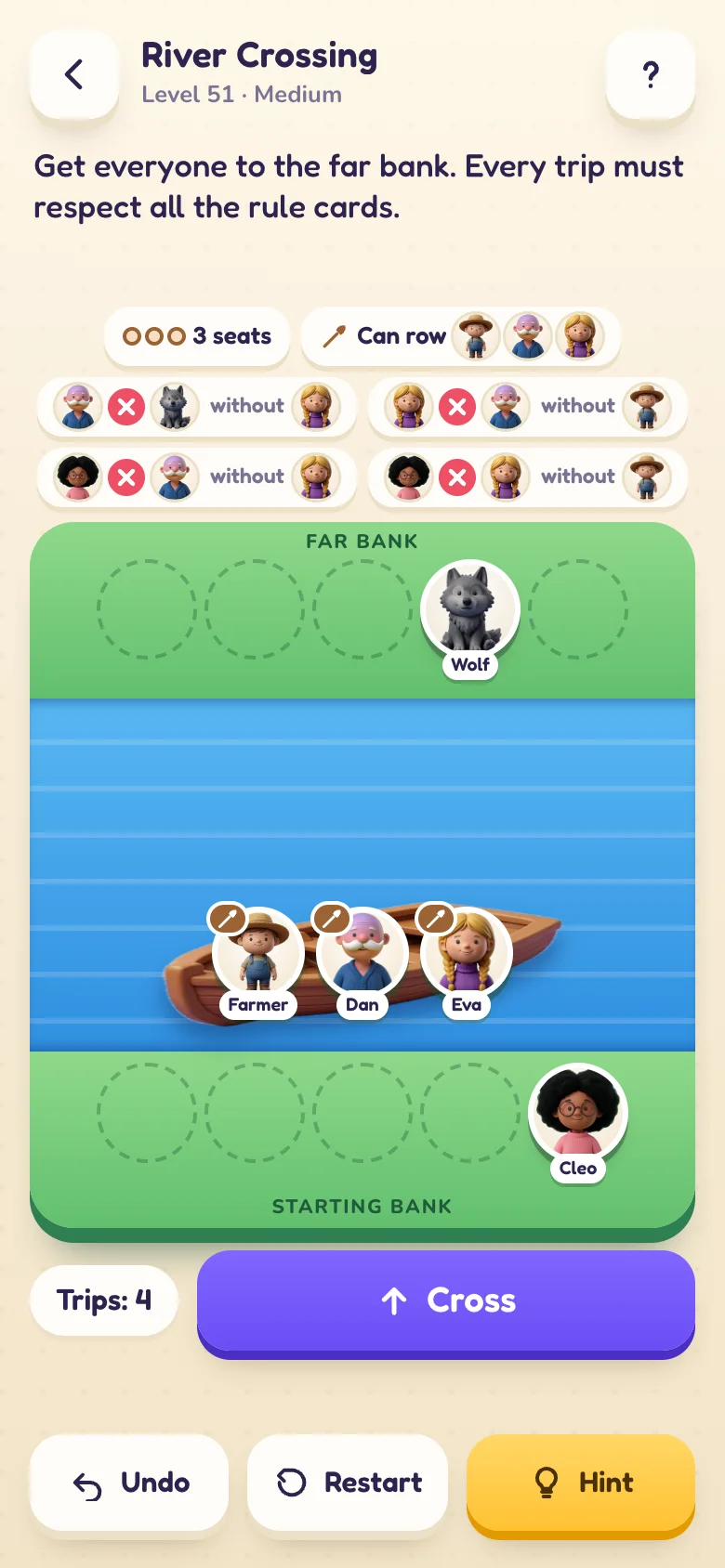
River Crossing
Ferry everyone across without leaving trouble behind.
How it is played
- Tap a passenger on the bank where the boat is to put them in the boat. Tap them in the boat to take them out. Press Cross to send the boat to the other bank.
- The boat never crosses empty: someone from the oar card must be on board. It holds no more passengers than it has seats and, when there is a weight card, no more weight than its limit.
- A card with two passengers, a red mark and a third passenger means the first two cannot be together without the third, on either bank or in the boat. Whoever sits in the docked boat counts as being on that bank. You win when everyone is on the far bank.
-
 Shapes and space · 120 levels
Turn & Fit
Turn the pieces until they fill the shape.
How it is played
- Tap a piece to give it a quarter turn around its white pin. The pin never moves.
- Pieces may overlap or stick out while you think. A red mark shows where something is wrong.
- You win when the dark shape is completely covered and no piece overlaps or sticks out.
-
 Shapes and space · 120 levels
Fill the Box
Pack every piece with no gaps.
How it is played
- Drag a piece into the box. Or tap a piece, then tap the square where its top-left block goes.
- Pieces cannot overlap, stick out of the box or cover a stone.
- Tap a placed piece to take it out. When the level allows it, the Turn button rotates the selected piece.
-
 Shapes and space · 120 levels
Split the Land
Fence the field into plots that match their numbers.
How it is played
- Drag from one corner of a plot to the opposite corner to fence it. Or tap a square, then tap the opposite corner.
- Every plot is a rectangle with exactly one number inside, and that number is how many squares the plot covers.
- Plots cannot overlap and no square may be left over. Tap a plot to remove it. A plot with a red dashed border and a ! breaks a rule.
-
Shapes and space · 120 levels
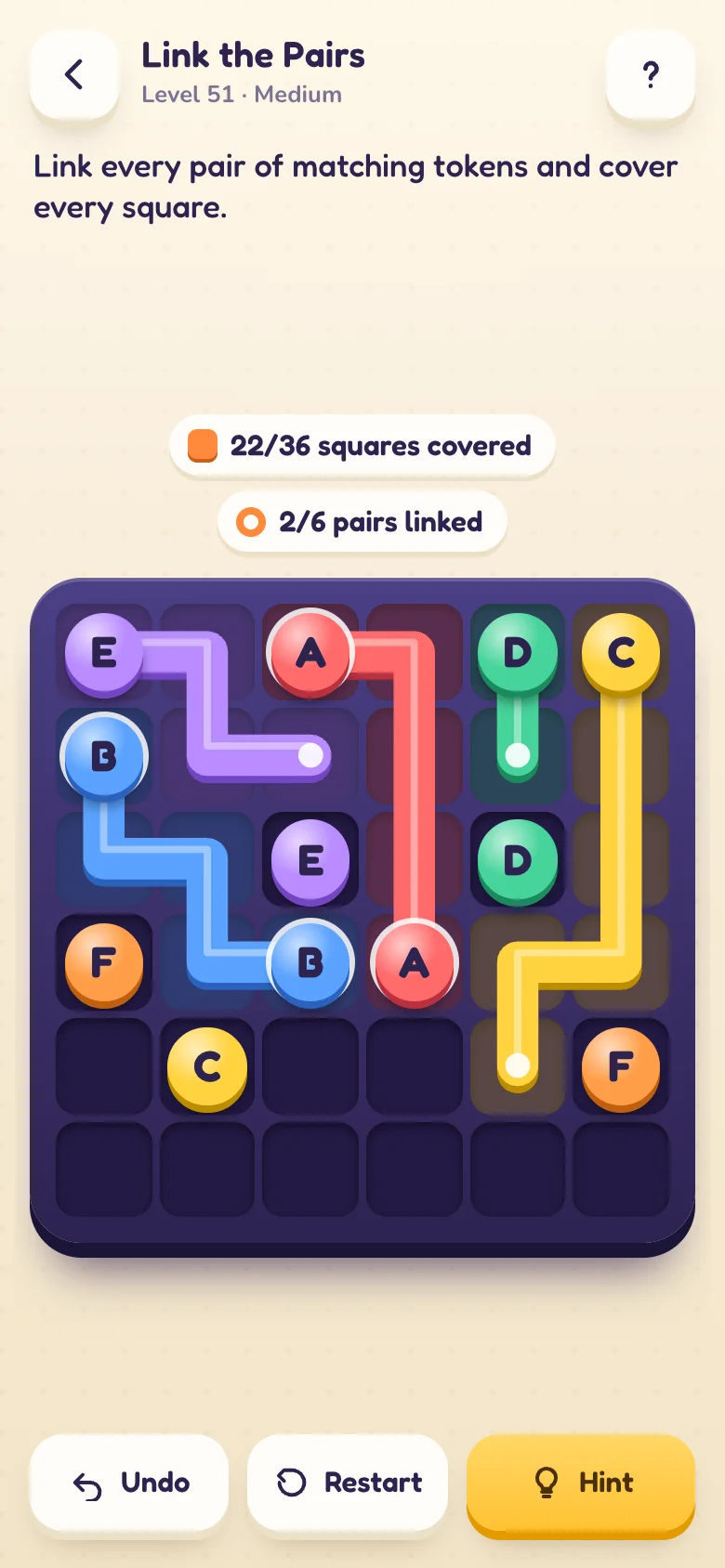
Link the Pairs
Join matching tokens and fill the whole board.
How it is played
- Drag from a token to draw a path, square by square (up, down, left or right), until it reaches the token with the same letter and color.
- Paths cannot cross, share a square or pass through another pair’s token. When you finish, every square on the board must be covered by a path.
- Drag back along a path to shorten it. Tap a token to erase its path. Drawing over another path cuts that path back.
-
Shapes and space · 120 levels
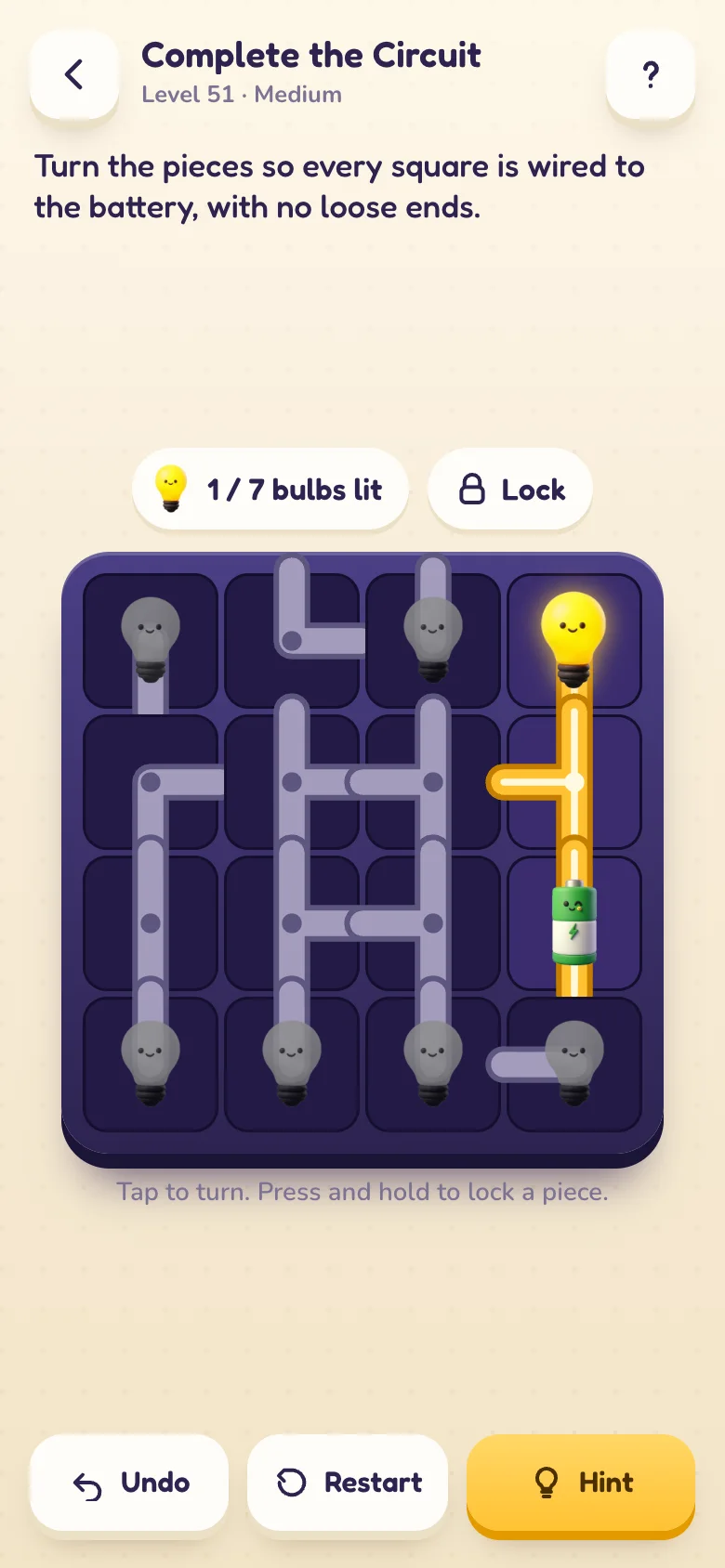
Complete the Circuit
Turn every piece of wire until the whole board is powered.
How it is played
- Tap a square to turn its piece of wire a quarter turn clockwise. Pieces never move or change shape; they only turn.
- You win when every square is joined to the battery in a single network. Every wire end must meet a wire end of the square next to it: none may point at the edge of the board or at the blank side of another piece.
- Wires joined to the battery light up, so you can watch the network grow. The finished network never forms a closed loop. Press and hold a square, or use Lock, to lock a piece you are sure about; locks are your own notes and never count.
-
 Shapes and space · 120 levels
Tilt Maze
Tilt the tray and stop the marble right on the goal.
How it is played
- Tap an arrow, or swipe across the tray, to tilt it toward that side of the screen. The marble rolls in a straight line until a block or the edge stops it; it never stops halfway.
- You win when the marble is stopped on the green goal with every star collected, without using more tilts than the counter allows. Rolling over the goal does not count, and a tilt that moves nothing is free.
- Dark holes: a tilt that would roll a marble into one is refused. Stars: roll over them to collect them. Two marbles: both roll at once, one stops against the other, and each goal needs a marble.
-
 Numbers · 120 levels
Numbers in Order
Fill the grid without repeating a number.
How it is played
- Tap a square, then tap a number. Tap the same number again to remove it.
- Every row and every column must contain each number exactly once. Wooden numbers are fixed.
- Use Notes to pencil in the numbers you are still considering.
-
 Numbers · 120 levels
The Scale
Work out what each shape weighs.
How it is played
- Every scale shown is perfectly balanced: both sides weigh the same.
- Each shape always weighs the same whole number. Gray blocks show their weight.
- Tap a shape below and give it a number. A scale turns green when its numbers add up.
-
 Numbers · 120 levels
Find the Rule
Spot the rule behind the row and fill in the missing tiles.
How it is played
- Every row follows one rule from start to finish. Tap a gap marked “?”, then tap the tile below that belongs in it. Tap another tile to change your answer, or the same one to take it back.
- Number rows: add, subtract, multiply, or divide by the same amount; two steps or two series taking turns; a jump that grows steadily; or each number is the sum of the two before it.
- Shape rows: shape, color, and dots each follow their own rule: stay the same, repeat every 2–4 tiles, or (dots only) go up or down by one. Answers are checked once every gap is filled.
-
 Numbers · 120 levels
Loads and Levers
Place the weights so the bar stays level.
How it is played
- Drag each colored weight from the tray to a free spot on the bar, or tap a weight and then a spot. Each spot holds one weight. Gray weights with a lock cannot move.
- A weight pushes its number times the distance printed on the bar under it: a 3 at distance 2 pushes 3 × 2 = 6. The board shows each product and the total push of each side.
- You win when every loose weight is on the bar and both totals are equal. Tap a placed weight and then the tray to take it back, or drop it on another weight to swap them.
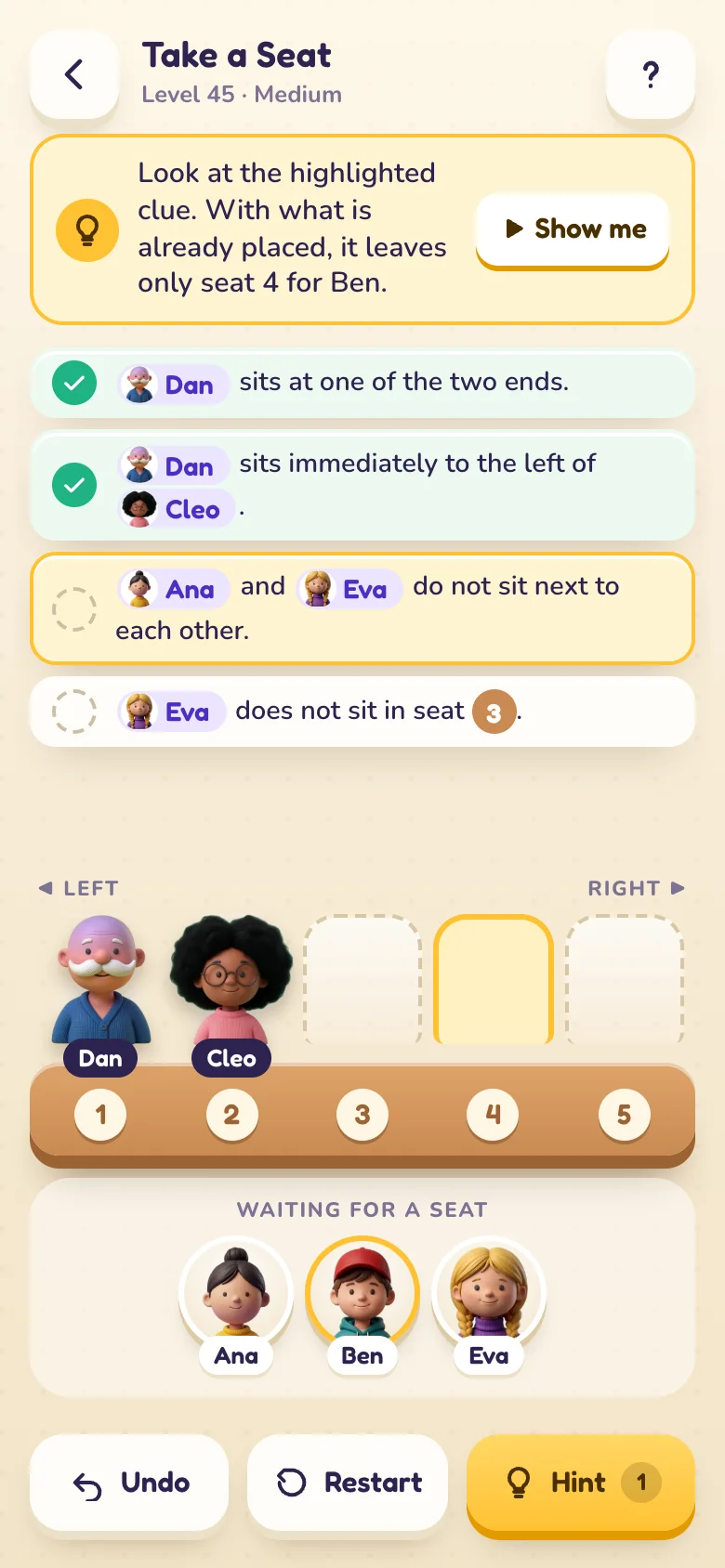
Hints that teach
A hint explains the step. It does not play it for you.
Stuck? The hint points at what the puzzle already tells you and says why the next step follows, so next time you spot it yourself. “Show me” is there if you would rather just move on.
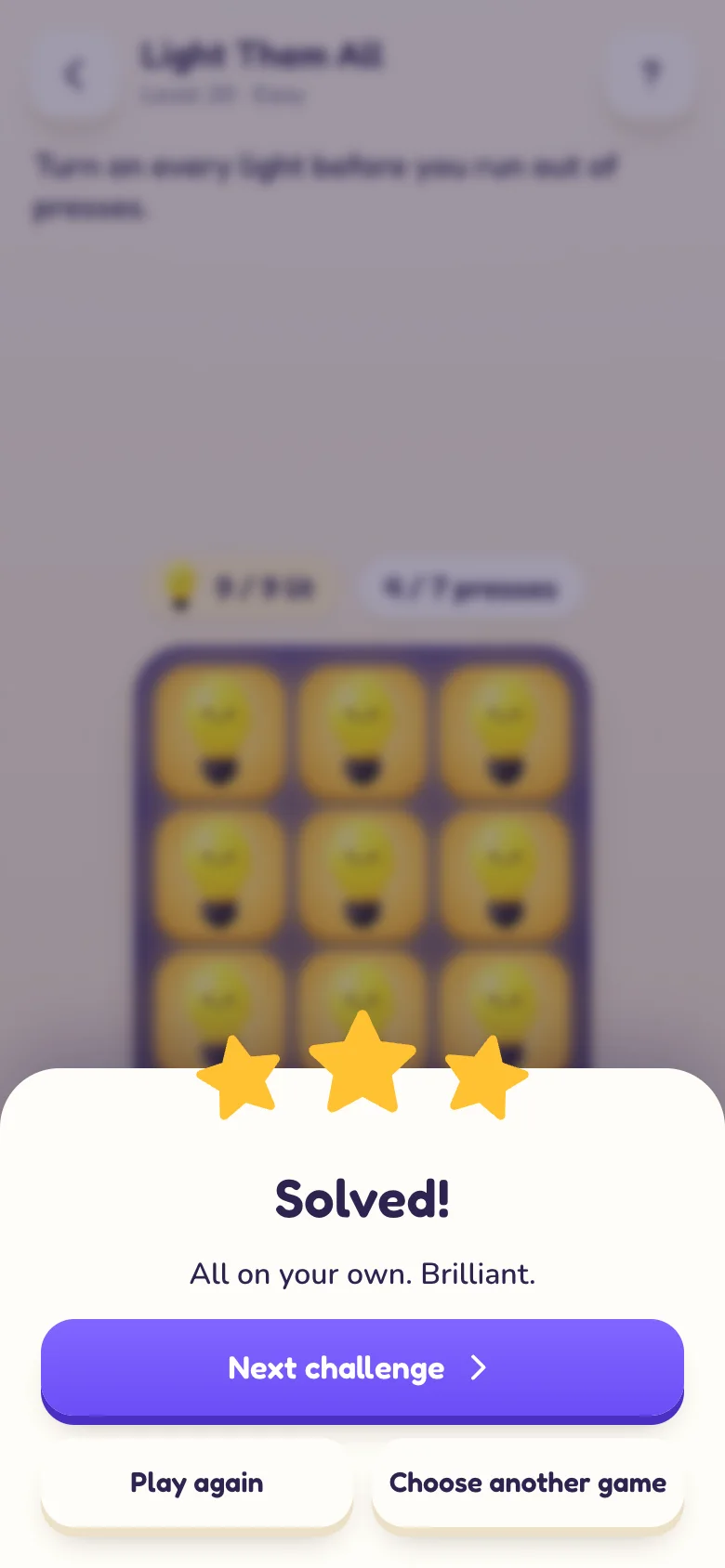
- Three stars for solving it all on your own.
- Two stars if you asked for one hint.
- One star with several hints. Solved is still solved.
- 22
- different games
- 2,640
- levels, every one verified
- 30
- languages
- 0
- timers
No pressure
Made for thinking calmly
A thinking game should leave you room to think. These are the rules we set for ourselves.
No timers
Nothing counts down and no energy runs out. Take ten seconds or ten minutes over a move.
Every level can be solved
A solver checks all 2,640 levels before they ship, and checks that the hints alone are enough to finish each one.
Works offline
The whole collection lives on your phone. On the train, on a plane or with no signal at all.
Saved after every move
Close the app mid-puzzle. It is waiting exactly where you left it.
Ads never interrupt a puzzle
They only appear between levels, never while you are thinking, and a single purchase removes them for good.
Comfortable for everyone
High contrast, larger text and reduced motion in the settings. No account and no email to get started.
Inside the app
Real screens, straight from the game
Guides
Get better at thinking games
How each puzzle works, the techniques that solve it and what thinking games can and cannot do for you.
- 7 min readThinking games: what they are and how to spot a good oneWhat counts as a thinking game, how it differs from reflex, trivia and trick games, the four kinds of reasoning involved and how to tell a fair puzzle.Read the guide
- 8 min readLogic puzzles: a map of the main typesA map of fifteen types of logic puzzles, from logic grid puzzles to sliding blocks: the rule of each, the reasoning it asks for and where to begin.Read the guide
- 9 min readHow to solve logic puzzles: eight techniques that work almost everywhereEight logic puzzle tips that work in almost any puzzle: start where there is least choice, eliminate, find the overlap, try cases, work backwards, use parity.Read the guide

Pick a game. Take your time.
Coming soon to Android, iPhone and iPad, in 30 languages.