Thinking games: what they are and how to spot a good one
A thinking game is a game you win by reasoning. Everything you need is on the board, the rules say exactly what is allowed, and the answer can be worked out and then checked. Speed does not help, and neither does knowing facts. This guide explains what separates a thinking game from other things that carry the same label, the four kinds of reasoning these games ask for, and how to tell a fair one from a frustrating one.
What makes a game a thinking game
Three things have to be true at once.
- All the information is in front of you. Nothing is hidden behind luck, and nothing depends on something you were supposed to know beforehand.
- The rules are complete. For any move, you can tell whether it is allowed without asking anyone.
- The answer can be proved. When you finish, you can point at each rule and see that it holds. Nobody has to tell you that you were right.
Sudoku, nonograms, sliding-block puzzles and river-crossing riddles all fit. So do chess problems. A crossword does not quite fit, because it leans on vocabulary. A quiz does not fit at all.
The useful test is simple: could a patient beginner who has only read the rules reach the answer? If yes, it is a thinking game. If the answer needs a fact, a fast hand or a lucky guess, it is something else. That something else may be great fun, but it trains a different thing.
How they differ from reflex, trivia and trick games
App stores and search results put very different games under "thinking games". Four kinds are worth telling apart.
| Kind | What decides the result | What a mistake teaches you |
|---|---|---|
| Reflex games | How fast and how precisely you react | To be quicker next time |
| Trivia | Whether you already know the fact | The fact |
| Trick games | Whether you guess what the author had in mind | That one trick, which will not come back |
| Thinking games | Whether your reasoning is sound | Which step was not justified |
Trick games deserve a closer look, because they are the ones most often sold as brain teasers. A typical level asks you to "find the biggest animal" and the answer is to shake the phone, or to drag a word out of the question. It is a joke with a punchline, and a good one can be delightful. But you cannot reason your way to the answer, because the rule that solves the level was never stated.
That is different from a proper lateral thinking puzzle, where the surprise is fair and you can reach it from what you see. We cover the difference in our guide to lateral thinking puzzles.
Timed "brain training" drills sit somewhere in between. The task is often a reasoning task, but the score depends on the clock, so in practice they reward quick pattern recognition more than careful thought.
The four kinds of reasoning
Most thinking games lean on one of four kinds of reasoning. The 22 games in Thinking Games are grouped the same way, so they make handy examples.
Deduction
You are given clues and you work out the only arrangement that satisfies all of them. Each step is a small proof: this must be here because it cannot be anywhere else.
In Take a Seat you seat characters from clues such as "Cleo is not at either end". In Crack the Lock you read the feedback on earlier attempts: if the attempt 1 2 3 has no digit in the code, then 1, 2 and 3 are out for good. Hidden Picture is a nonogram and Lonely Stars is a star-placement puzzle; both are solved square by square, with a reason for every square.
Planning
Here the rules are easy and the difficulty is the order of your moves. A move that looks helpful now can block you five moves later, so you have to look ahead.
Clear the Way is a sliding-block puzzle: to free the red car you first have to move the block that blocks the block. River Crossing is the old ferry riddle with rule cards. Program the Robot makes you write all the moves before anything happens. Clever Path, Light Them All, Build Bridges, One Stroke and Domino Chain belong here too.
Shapes and space
These games ask you to picture how pieces fit, turn or travel before you touch them.
In Fill the Box you pack pieces with no gaps, and the corner that only one piece can reach is usually the place to start. Turn & Fit gives each piece a fixed pin to rotate around. Split the Land cuts a grid into rectangles of given sizes. Link the Pairs, Complete the Circuit and Tilt Maze complete the group.
Numbers
The arithmetic is small. What matters is the relationship between quantities.
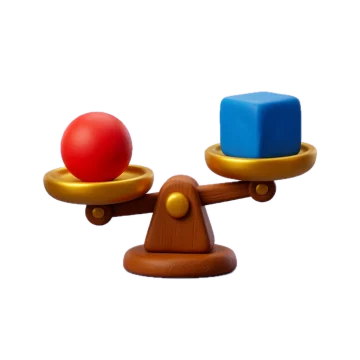
In The Scale, two circles balance a 6 and a circle plus a triangle balance an 8, so a circle weighs 3 and a triangle weighs 5. Numbers in Order is a Latin square, like a sudoku without boxes. Find the Rule asks what a row is doing: 2, 5, 8, ?, 14 adds 3 each time, so the gap is 11. Loads and Levers adds distance: a 3 placed two steps from the support pushes as hard as a 6 placed one step away.
The families overlap. Build Bridges is filed under planning but its best moves are pure deduction. That is normal: a good puzzle rarely uses one skill alone.
How to recognize a good one
Whether you are choosing a book of puzzles, a website or an app, the same four checks apply.
- The rules fit in a few lines and have no exceptions. If you need to play ten levels to find out what is allowed, the game is testing your patience.
- The solution can be demonstrated. A good game checks your answer against the rules, so any arrangement that satisfies them counts. A weak one compares you with a stored answer and rejects a valid alternative.
- You never have to guess. There should always be a next step that follows from what is on the board. If you are stuck, it means you have not seen it yet, and a good hint shows you where to look and why.
- There is no hurry. A countdown turns reasoning into reacting. The same goes for lives or energy that run out when you make a mistake: they punish the trial and error that learning needs.
Two smaller signs are worth a look. Difficulty should grow by adding an idea, and a bigger board alone is a poor substitute. And undo should be free, because taking a move back is part of thinking.
For reference, this is how Thinking Games handles those points. Each game states its rules in three lines. Levels are generated and verified by a program before they ship. Nothing is timed, and hints explain the deduction before offering the move. It shows ads, never during a level, and a one-time purchase removes them. Nobody has yet measured how hard each level feels to real players, so the easy, medium and hard labels are the generator's estimate.
How to start
Pick the family that sounds most like you, and start small.
- If you like detective stories, start with deduction: a seating puzzle or a small nonogram. Our nonogram guide walks through a 5×5 grid square by square.
- If you like chess or route planning, try a sliding-block or river-crossing puzzle.
- If you were the child with the building blocks, try packing and rotation puzzles.
- If you enjoy mental arithmetic, try balance puzzles and Latin squares.
Whatever you choose, three habits make the first sessions go better.
- Read the rules twice. Most early mistakes are a rule read too quickly, such as forgetting that stars may not touch even at a corner.
- Look for the forced move. Before trying anything, ask which square, piece or step has only one option. There is nearly always one.
- When you take a hint, ask why it is true. The move itself is worth little. The reason behind it is what you will reuse on the next level.
Short sessions are enough. Fifteen minutes spread over three different kinds of puzzle is a quick way to find out which kind you enjoy. When you want general techniques that work across puzzles, see how to get better at logic puzzles, or browse the guides to each game.
Frequently asked questions
What is a thinking game?
A game you win by reasoning from stated rules, with all the information visible and an answer you can check. Logic puzzles such as nonograms, sudoku-style grids, sliding blocks and river-crossing riddles are thinking games. Reflex games, quizzes and games of chance are not.
Are thinking games the same as brain training?
No. "Brain training" is a claim about what happens to you after playing. A thinking game is only a kind of game. Playing one makes you better at that puzzle and at puzzles like it; whether anything carries further is a separate question, and we look at the evidence in what research says about brain games.
Are riddles and trick questions thinking games?
Some are. A riddle whose answer follows from its wording is a fair lateral thinking puzzle. A level whose answer is an unannounced gesture, such as shaking the phone, is a trick: fun once, but there is nothing to reason about.
Do thinking games have to be hard?
No. A 3×3 Latin square is a thinking game and takes a minute. What defines the genre is that the answer is reached by reasoning. Difficulty comes later, from larger boards and from steps that need two ideas combined.
What thinking games are in the Thinking Games app?
Twenty-two, with 120 levels each: four deduction games, eight planning games, six about shapes and space, and four about numbers. It is an app for iOS and Android and it works offline. It has no daily challenge, no multiplayer and no browser version.